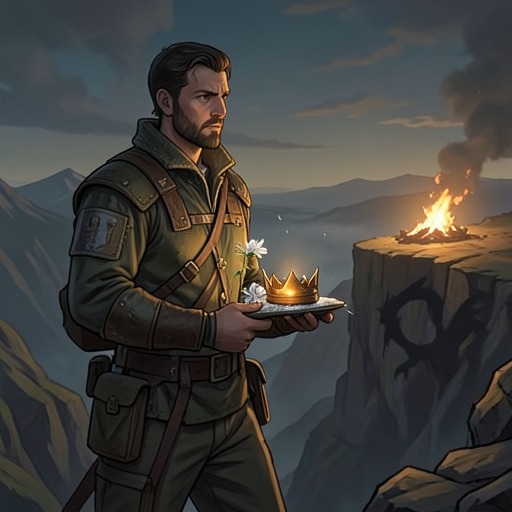
Stannis–Cortnay Penrose conflict
A Clash of KingsThe Stannis–Cortnay Penrose conflict is the decisive confrontation surrounding Stannis Baratheon’s siege of Storm’s End. Stannis claims the castle as his by right and offers terms intended to make surrender appear measured and lawful, but Ser Cortnay Penrose treats the demand as treasonous coercion rather than a legitimate settlement. The dispute becomes especially charged because Stannis also requires the surrender of Edric Storm, his brother’s bastard. Cortnay’s refusal preserves the garrison’s defiance at the cost of his own life; after he dies, Storm’s End opens its gates to Stannis.
The Siege and Stannis’s Demand
Stannis summons Cortnay after giving him a fortnight to consider an offer and after Cortnay’s ravens have brought no help. Storm’s End therefore stands isolated, and Stannis declares that his patience is exhausted. His demand is not merely that the castle admit his army: Cortnay must open the gates and deliver to Stannis what Stannis believes belongs to him by right. The language of legal entitlement places the immediate military crisis inside the larger struggle over kingship, where possession of a stronghold becomes a test of whether Stannis’s claim will be recognized.
Stannis presents surrender as a controlled exchange rather than simple destruction. He promises to pardon Cortnay for treason, as he has pardoned the lords gathered behind him, and allows the garrison’s men either to enter his service or return home unharmed. They may keep their weapons and as much property as each man can carry, while Stannis claims their horses and pack animals. Yet the apparent generosity has a hard boundary: Edric Storm must be surrendered. The demand transforms the offer from a military capitulation into the delivery of a politically valuable person, making Cortnay’s decision a question of custody and protection as well as obedience.
Cortnay’s Refusal and Challenge
Cortnay’s answer remains no. He does not accept Stannis’s pardon, his terms, or the premise that the castle can be yielded without violating his duty. When Stannis clenches his jaw and falls silent, Melisandre speaks in his place, invoking the Lord of Light’s protection over Cortnay in his darkness. Her blessing functions less as reassurance than as a warning: the negotiation has already begun to acquire a religious and fatalistic frame, with Cortnay positioned against the power supporting Stannis’s claim.
The confrontation sharpens when Cortnay challenges the account of Renly Baratheon’s death. Stannis insists that the Lord of Light willed his brother to die for treason and that the identity of the killer does not matter. Cortnay rejects that evasion and answers with a direct personal challenge. He removes his glove and throws it into Stannis’s face, offering single combat with sword, lance, or any weapon Stannis chooses. If Stannis fears to risk his magic sword and royal person, Cortnay offers to fight a champion instead, pointedly naming Guyard Morrigen and Bryce Caron as suitable opponents. Both men volunteer, but the challenge exposes the gulf between Stannis’s claim to divine and legal authority and Cortnay’s insistence that responsibility must be answered in personal terms.
The Succession Calculation
The dispute is also shaped by the likely consequences of Cortnay’s death. Davos Seaworth explains to Stannis that Cortnay’s lieutenant, Lord Meadows, is a twenty-year-old cousin of the Fossoways. If an ill chance removes Cortnay, command of Storm’s End will pass to this young man, whom his cousins believe would accept Stannis’s terms and surrender the castle. Stannis recalls another young commander who once held Storm’s End and failed to yield it, while Davos distinguishes Lord Meadows from himself by describing Meadows as less stubborn.
This calculation reveals the siege’s ruthless structure. Cortnay’s resistance is not treated only as a matter of honor; his survival is an obstacle, and his death may produce the surrender that negotiation cannot obtain. The castle’s fate can therefore be altered without conquering its walls, by replacing one commander with another whose judgment is expected to be more pliable. Davos’s argument also shows the tension within Stannis’s camp between military expediency and the moral language of rightful kingship: the commander may be offered terms, but the strategic value of his removal is openly weighed.
Death and Aftermath
The conflict ends through Cortnay’s death rather than through acceptance of Stannis’s conditions. When Varys later brings Tyrion Lannister the news, he reports two linked facts: Ser Cortnay Penrose is dead, and Storm’s End has opened its gates to Stannis Baratheon. The sequence confirms the practical consequence of the confrontation. Cortnay’s refusal holds while he commands, but once he is gone, the castle passes into Stannis’s control.
Tyrion’s reaction gives the result a political shock beyond the walls of Storm’s End. Dismay drives every other thought from his mind; when Shae returns with wine, he takes a sip and throws the cup away, where it shatters against the side of the house and the wine runs down the stones. His curse is deliberately ambiguous, directed either at Cortnay or at Stannis, and that ambiguity captures the conflict’s central reversal. Cortnay’s death is an act of defiance that achieves no lasting military victory, while Stannis’s victory depends on the disappearance of the man who refused him.
Significance of the Conflict
The confrontation stages a collision between competing kinds of legitimacy. Stannis speaks through rights, pardon, command, and the authority of the Lord of Light; Cortnay answers through duty, accountability, and the embodied risk of single combat. Stannis’s terms appear to protect the garrison, but the requirement that Edric Storm be handed over reveals the coercive purpose beneath the offer. Cortnay’s refusal, by contrast, protects the principle that surrender is not acceptable merely because it is made administratively convenient.
The conflict also joins personal honor to political consequence. Cortnay’s glove thrown into Stannis’s face turns a siege negotiation into an accusation, while the later opening of Storm’s End demonstrates how fragile a political position can be when it depends on one commander’s continued presence. The outcome gives Stannis the castle, but it does not erase the challenge Cortnay posed: the gates open only after the defender who demanded an answer has been removed. In that sense, the episode presents victory as both strategic success and moral unease, with the castle changing hands while the question of who truly bears responsibility remains unresolved.